A baby bird that cheats at life—and an algorithm that learns from it
A cuckoo chick hatches in a stranger’s nest, then heaves the host’s eggs over the edge. Ruthless—but effective. In 2009, two researchers turned that strategy into a new way to solve hard optimization problems, and it beat popular methods on a battery of tests.
A search strategy borrowed from birds
Cuckoo Search (CS) is a “metaheuristic”: a general recipe for searching complex spaces, not a problem‑specific trick. Like other nature‑inspired methods, it balances two drives borrowed from evolution: intensification (double down on what works) and diversification (keep exploring).
The algorithm is built on three idealized rules:
- Each “cuckoo” lays one egg in a randomly chosen “nest.”
- The best nests carry over to the next generation.
- A fixed fraction p_a of the worst nests are discovered and abandoned, replaced with new nests.
In math terms, a nest is a candidate solution vector x. In this paper, each nest holds one egg—one candidate. Fitness is the objective value (for minimization problems, “better” means lower). The mechanics are simple: generate a new candidate, compare it to a randomly chosen nest j, and if it’s better, replace j. That random duel injects mild selection pressure without collapsing the whole population onto a single point too quickly.
Abandonment (controlled by p_a) keeps the search from getting stuck: the worst fraction is thrown out and replaced by fresh, uniformly random candidates inside the allowed bounds. Elitism ensures the very best nests survive each round.
Why Lévy flights matter
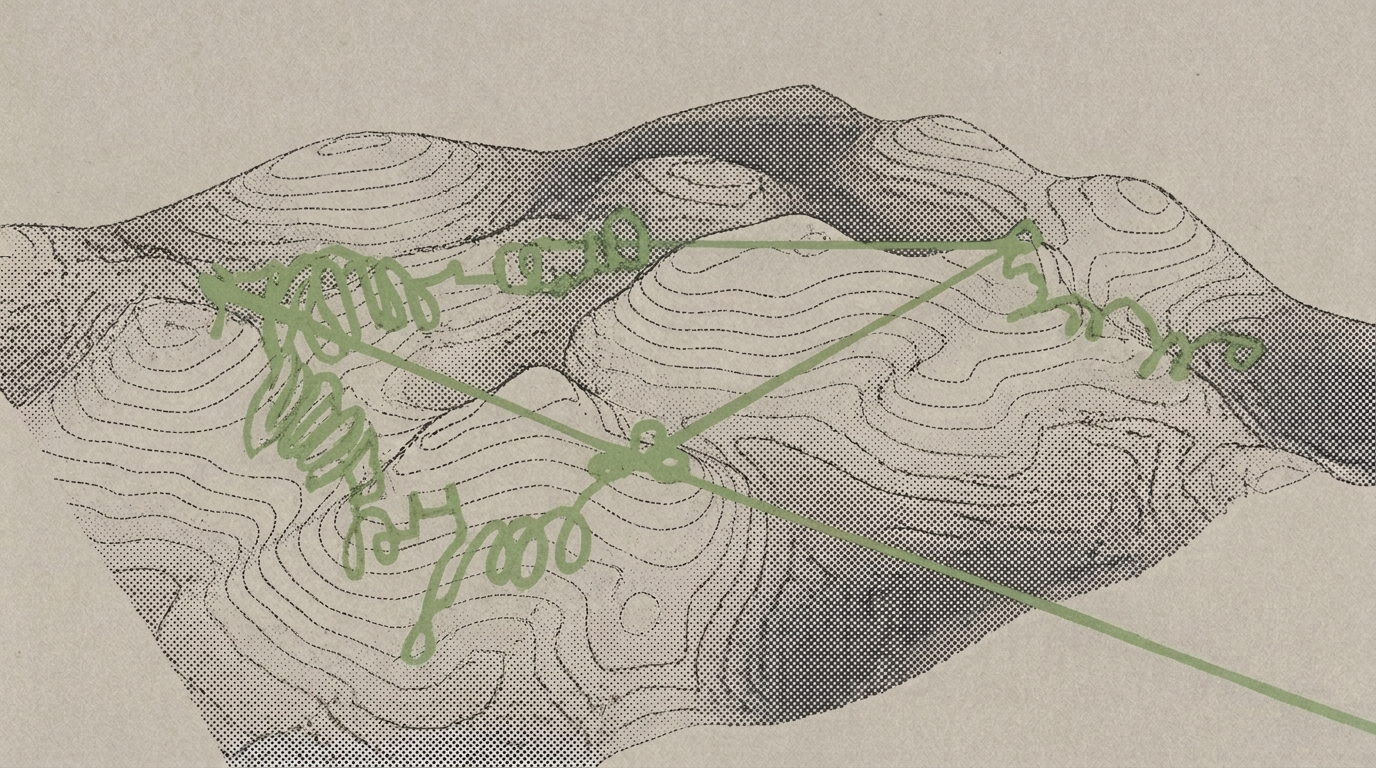
The most distinctive ingredient is how CS explores. It doesn’t take timid, uniform steps. It moves like many animals foraging in the wild: lots of short moves punctuated by rare, long jumps. This pattern—seen in fruit flies, hunter‑gatherers, even light paths in disordered media—is called a Lévy flight.
CS generates new solutions with a Lévy‑flight step:
x_i^(t+1) = x_i^(t) + α ⊗ Levy(λ)
Here α is a step size (often 1), “⊗” means component‑wise scaling, and Levy(λ) denotes a heavy‑tailed random vector whose step lengths follow a power law with exponent λ in (1, 3]. Heavy tails mean infinite variance: many small steps, but occasional leaps that cross valleys. That’s the exploration engine.
CS uses those moves in two ways at once. Around good nests, Lévy steps sharpen promising solutions—intensification. Meanwhile, far‑field randomization comes from rare long jumps and from abandoning the worst nests—diversification. The result is a built‑in balance the field often has to tune by hand.
In practice, the authors found a small population works: 15 to 50 nests, with p_a around 0.25 and α = 1. They report the method’s convergence is relatively insensitive to these settings, so there’s little fine‑tuning fuss.
What the tests show
Yang and Deb validated CS on a broad slate of standard benchmarks that cover smooth bowls, spiky multimodal terrains, and deceptive valleys (Sphere/De Jong, Rosenbrock, Ackley, Rastrigin, Griewank, Schwefel, Michalewicz, Easom, and Shubert’s function with 18 global minima). They ran each algorithm at least 100 times and stopped when the spread of function values fell below 1e−5.
Across the board, CS reached the global optimum with a 100% success rate and needed far fewer function evaluations than two mainstays: genetic algorithms (GA) and particle swarm optimization (PSO). A few snapshots:
- Sphere in 256 dimensions: CS ≈ 5,000 evaluations vs. GA ≈ 25,000 and PSO ≈ 17,000.
- Ackley in 128 dimensions: CS ≈ 4,900 vs. GA ≈ 32,000 and PSO ≈ 23,000.
- The rugged 16‑dimensional Michalewicz: CS ≈ 3,200 vs. GA ≈ 89,000 and PSO ≈ 6,900.
On multimodal landscapes, a striking behavior emerges: nests don’t all collapse onto one spot right away. They gather around several local optima before the best one wins out. With enough nests, CS can map multiple optima in a single run—useful when the goal is to understand a landscape, not just find its single best point.
Two design choices likely drive the gains. First, heavy‑tailed steps accelerate escapes from local traps without the need for elaborate schedules. Second, the algorithm has only two main knobs (population size n and abandonment fraction p_a), reducing the risk of mis‑tuning that plagues many competitors.
Why it matters—and what’s next
Many real‑world problems—from engineering design to scheduling to machine‑learning hyperparameters—look like the test functions: bumpy, high‑dimensional, full of decoy peaks. CS offers a compact, robust starter kit for those cases, with competitive speed and minimal setup.
There’s room to grow. The same mechanics can support multiobjective search by keeping an archive of nondominated nests, and variants could handle constraints by projecting infeasible steps back into bounds or penalizing them. Theory lags practice here; formal convergence guarantees and ablations would clarify exactly how much the Lévy component contributes versus elitism and abandonment.
But the core lesson is already clear. By letting a few bold jumps and a bit of ruthless selection do the heavy lifting, a baby bird’s survival trick becomes a powerful way to find what’s best—one nest at a time.