An algorithm that wins by holding back. A recent “ppo‑min” study strips Proximal Policy Optimization to its essentials and explains the tiny “min” that makes the whole thing work.
The puzzle: why smaller steps learn faster
Reinforcement learning agents get better by changing how they act, but big swings often wreck what they’ve learned. Earlier methods like Trust Region Policy Optimization (TRPO) enforced careful, small moves with a heavy optimization constraint. PPO keeps the same spirit with a simpler move: it punishes updates that stray too far from the current policy.
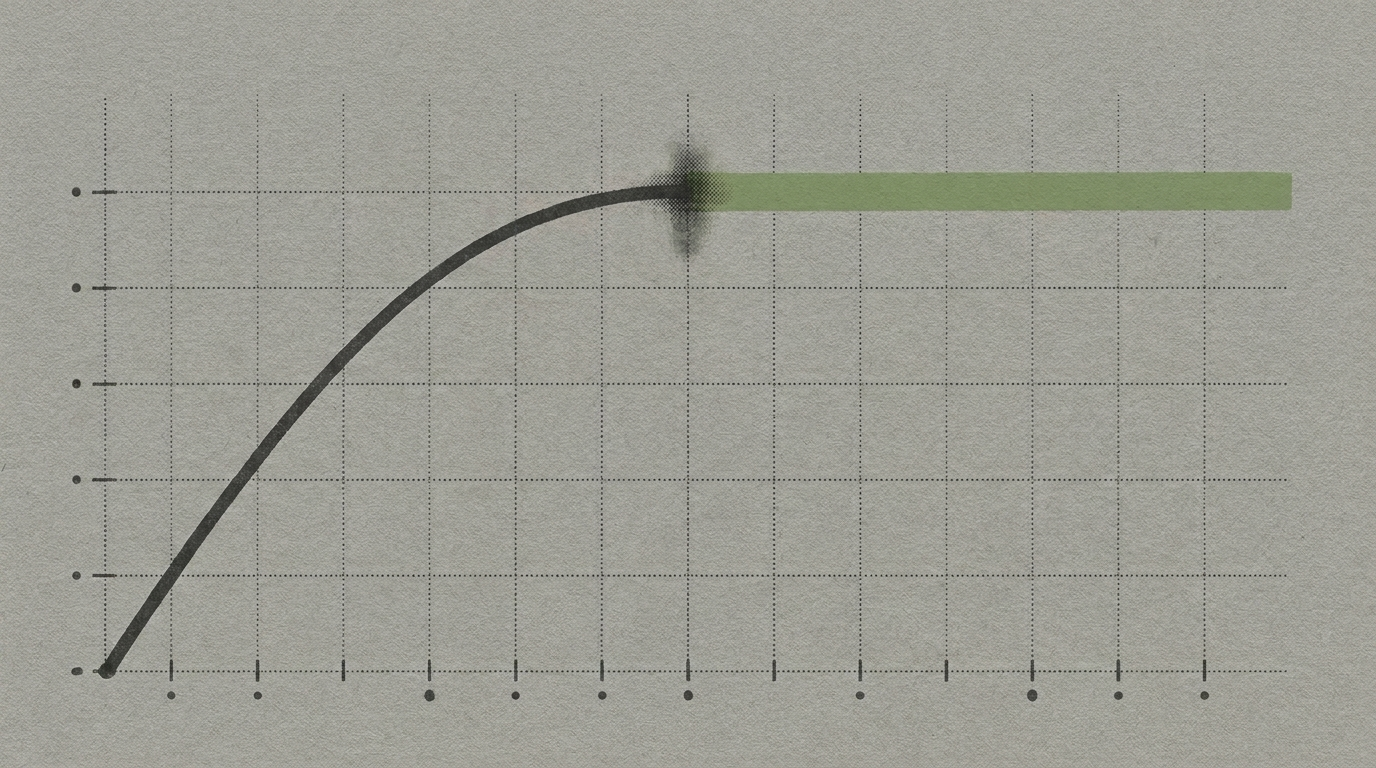
The core trick is a “clipped” objective. For each action, the algorithm forms a probability ratio r_t = πθ(a|s) / π_old(a|s) and multiplies it by an advantage estimate A_t (how much better that action was than average). If r_t shoots above 1+ε or below 1−ε, PPO clips it back. Then comes the subtlety: it takes the minimum between the unclipped and clipped terms. That “min” acts like a fuse. It picks the pessimistic version so the optimizer has no incentive to push probability ratios past the safe zone, even when the raw gradient begs for it.
Think of it as a seatbelt: it tightens when you yank, but otherwise stays out of your way.
A tiny notation key
πθ: current policy
π_old: policy used to collect the data
r_t = πθ(a|s)/π_old(a|s): probability ratio
A_t: advantage estimate (often from GAE)
V(s): value baseline
γ: discount factor
λ: GAE parameter
ε: clip range (policy)
c1, c2: weights for value loss and entropy bonus
What “minimal PPO” keeps—and what it cuts
The minimalist recipe keeps the parts that do the real work:
- On‑policy rollouts in short batches.
- Generalized Advantage Estimation (GAE) for lower‑variance
A_t, with advantages standardized per batch. - The clipped policy loss with the “min” operator, a value loss (often also clipped), and a small entropy bonus for exploration.
- Multiple epochs of SGD over the same batch, broken into minibatches.
- Optional gradient‑norm clipping and observation normalization for stability.
And it cuts the rest: no trust‑region solver, no replay buffer, no target networks. That simplicity is why practitioners reach for PPO first—fewer moving parts, reliable learning curves.
Why the tiny “min” matters
Without the “min,” a clipped term alone can still leak incentives that encourage overshooting. Suppose A_t > 0 (the action helped). The raw objective r_t·A_t begs you to increase r_t. Clipping caps it at (1+ε)·A_t, but if you only optimize the clipped term, the gradient can go flat in the interior and weird at the boundary. By taking the element‑wise minimum of unclipped and clipped objectives, PPO explicitly picks the lower (more conservative) improvement estimate. That choice makes the loss a pessimistic bound: if the update pushes ratios beyond the trust zone, the objective refuses to count those extra “gains.”
Flip the signs and the same logic protects against collapsing good actions when A_t < 0. The “min” prevents the optimizer from gaming the clip, and in practice it’s what turns a clever idea into stable training.
Tuning that actually moves the needle
- Clip range ε: Wider means faster moves but more instability; tighter is steadier but can under‑update. Many schedules keep ε fixed or shrink it modestly over training.
- Epochs and minibatches: More epochs squeeze information from the same data but risk overfitting on‑policy samples. There’s a sweet spot; doubling epochs rarely doubles progress.
- Entropy: A small entropy bonus delays premature convergence and reduces “policy collapse,” especially in sparse or deceptive tasks.
- Value loss and its clip: A clipped value loss prevents the critic from lurching, which otherwise whipsaws the advantages.
- KL monitoring or early stop: Watching the KL divergence between old and new policy and halting an update when it spikes is a cheap safety latch.
- Time‑limit handling: If episodes end due to a time cap, treat them as truncations and bootstrap the value; otherwise you inject a bias that quietly hurts.
- Continuous actions: If you use tanh‑squashed Gaussians, correct log‑probs for the squashing transform. It’s a one‑line fix that avoids subtle training drift.
Where PPO shines—and where it doesn’t
PPO thrives when you need sturdy, predictable improvement with minimal fuss: continuous control, many game‑like benchmarks, and real‑world settings where conservative updates matter. Its on‑policy nature makes credit assignment cleaner and reduces replay‑induced instability.
It struggles when data is precious or tasks are brutally sparse. Off‑policy methods like Soft Actor‑Critic often win on sample efficiency in continuous domains. And clipping can under‑update when advantages are tiny or noisy; normalization helps, but the bias is real. Large, high‑dimensional action spaces can also blunt PPO’s edge unless exploration and scaling are handled with care.
One reason PPO shows up in training language models with human feedback (RLHF) is this reliability: small, guarded steps keep language quality from whipsawing while still nudging behavior toward human preferences.
The bigger picture
The lesson of “ppo‑min” is disarmingly simple: guardrails, not gimmicks. A single conservative choice—the little “min” that refuses to overcount risky gains—turns a delicate reinforcement learner into a dependable workhorse. In a field that often chases novelty, that restraint might be the most powerful move of all.