For years, the technology industry assumed that fixing a poorly lit photograph required a massive artificial brain. Whenever a camera faced a blinding sun or a pitch-black alley, engineers deployed heavy, data-hungry deep learning models to hallucinate the missing details. These artificial intelligence systems study millions of perfectly lit reference images just to learn how to recover a single stubborn shadow.
But relying on colossal neural networks creates a fatal trap. If you feed the software an unpredictable, real-world scene it has never studied, the system panics and mutates the colors. Even worse, the sheer computing power required to run these models causes standard devices to stutter.
What if the quest to build a more intelligent camera was entirely the wrong approach?
The learning-free rebellion
A team of computer vision engineers recently decided to abandon the artificial intelligence arms race. They built the Practical Exposure Corrector, or PEC, a software tool that skips deep learning entirely. Instead of teaching a computer what a good photograph looks like using massive training datasets, they solved the problem with a lightweight, self-regulating mathematical formula.
By tossing out the training data, the team created a “learning-free” software paradigm. Because the code does not rely on rigid memories of past photos, it adapts cleanly to wildly unfamiliar environments.
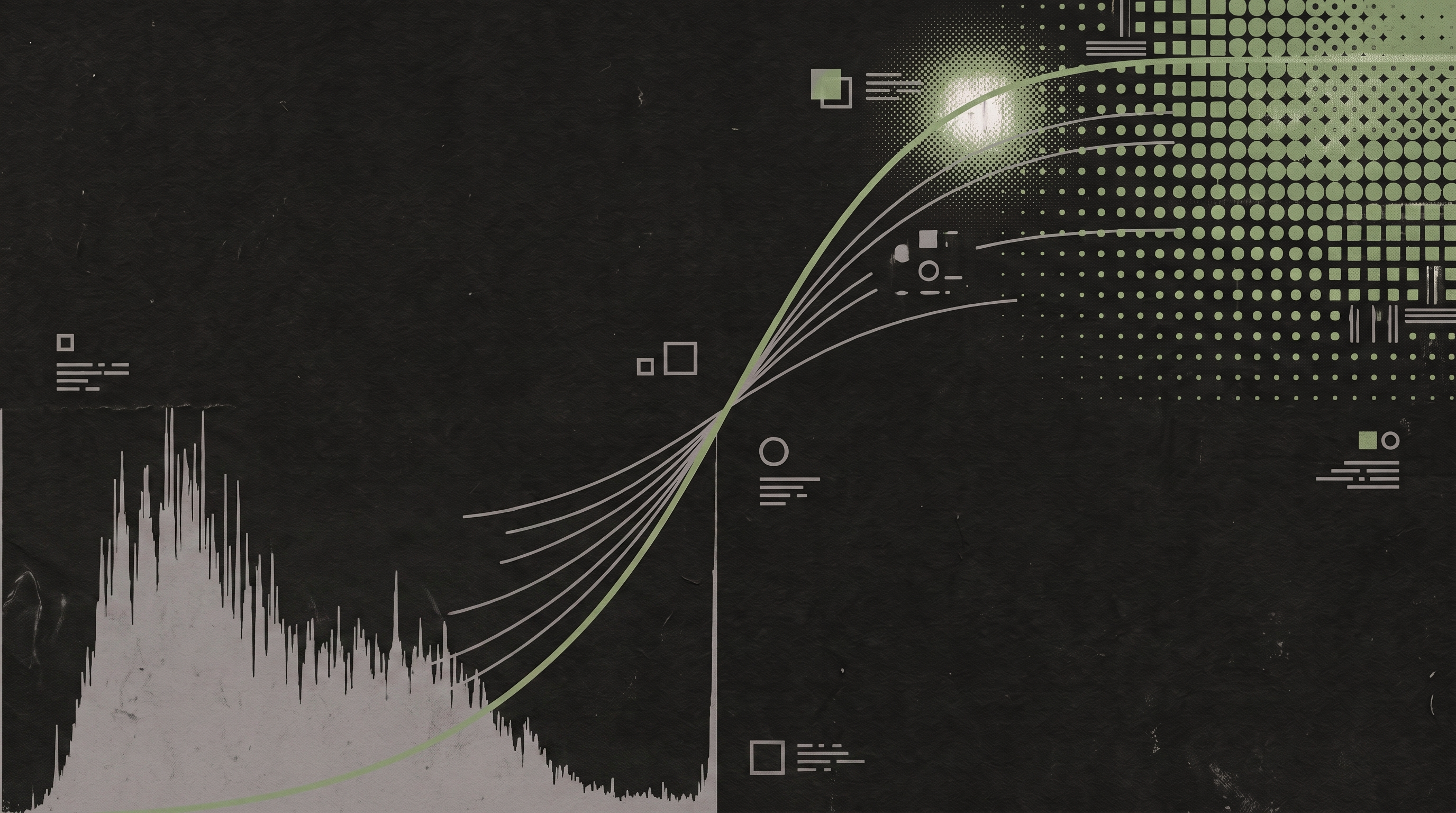
How exactly do you correct an image without teaching a computer what light looks like? You build a numerical map. The engineers realized that every pixel in a photograph exists on a raw scale from zero (pure black) to one (pure white). If they could design the precise mathematical curve, they could guide those raw numbers toward the middle without crushing the original physical reality of the scene.
But first, the algorithm needed a way to instantly judge the visual problem.
A mathematical tug-of-war
The algorithm kicks off by calculating the average brightness of the entire image. If the mean pixel value falls below exactly 0.5, the software treats the photo as underexposed and prepares to add light. If the mean sits above 0.5, it prepares to subtract light.
Once the system chooses a direction, it feeds the pixels into an exposure adversarial function. In computer science, an “adversarial” system usually pits two forces against each other to find an equilibrium. For this tool, the mathematical formula effectively multiplies the original pixel value by its exact numerical opposite.
Imagine a physical tug-of-war. If a pixel is already pure black or pure white, the equation zeroes out, dropping the rope entirely and leaving the darkest shadows and brightest highlights alone. For the messy mid-tones, the opposing mathematical forces pull against each other to find a natural balance. This simple curve avoids the trap of blindly brightening everything, which would otherwise wash out the entire picture.
To nudge the image toward clarity, the software initiates a “warm start.” Just as you might gently prime a cold engine, the system applies the adversarial math once. This single pass brightens or darkens the scene while strictly preserving the existing physical contrast.
Shrinking toward perfection
A single mathematical nudge rarely saves a severely degraded photograph. The algorithm must loop the adjustment over and over to drag hidden details out of the dark.
Left without a leash, a repeating algorithm will escalate its changes, brightening an image until it vanishes into pure static. To stop this, the developers deployed an iterative shrinkage scheme. As the software runs its light-adjusting formula a second and third time, the equation naturally demands progressively smaller fractional tweaks. The corrections physically “shrink” with each cycle. This built-in constraint acts like a digital brake pedal.
By the third loop, the image stabilizes. The entire sequence happens algorithmically, without humans needing to tweak complex software dials.
Blazing fast calculations
When engineers subjected this simple math to active tests, it obliterated the leading supercomputing models. Because PEC sheds the bloated architecture of neural networks, it processes visual data at blistering speeds. When adjusting a highly detailed 2K resolution image, the algorithm finished the job in 0.0009 seconds. That equates to over 1,100 frames per second, an operational velocity that makes it powerful enough to process live video directly on a standard smartphone chip.
The software also excelled in “no-reference” testing. Unlike lab conditions where a computer compares its work against a perfectly lit ideal photograph, chaotic physical environments offer no such luxury. When unleashed on grainy night shots and glare-heavy outdoor scenes, this lightweight math cleanly recovered hidden structures without spawning the weird, glowing artifacts that routinely confuse neural networks.
While the algorithm does struggle to balance extreme high-dynamic-range scenes—like a blinding sky stacked right next to a pitch-black room—its raw efficiency fundamentally reframes how machines should process visual reality.
We spent the last decade building gargantuan digital brains to help our cameras see in the dark. As it turns out, the universe does not always demand complex artificial intelligence to reveal its hidden contours. Sometimes, an elegant, lightning-fast equation is all you need to bring the world into focus.