Imagine tracking a mutating, deadly virus through an entire population, only to find that the very mathematics required to predict its next move completely freeze up. This is a quiet crisis evolutionary biologists face when they try to analyze massive collections of genetic data. Tracing a pathogen back to patient zero requires mapping its history on a branching diagram called a phylogenetic tree. But when researchers try to find the “average” shape of thousands of these virus trees to spot an evolutionary trend, standard math breaks down. The numbers get trapped in a geometric glitch, refusing to move no matter how the underlying data changes.
The Trap of Tree Space
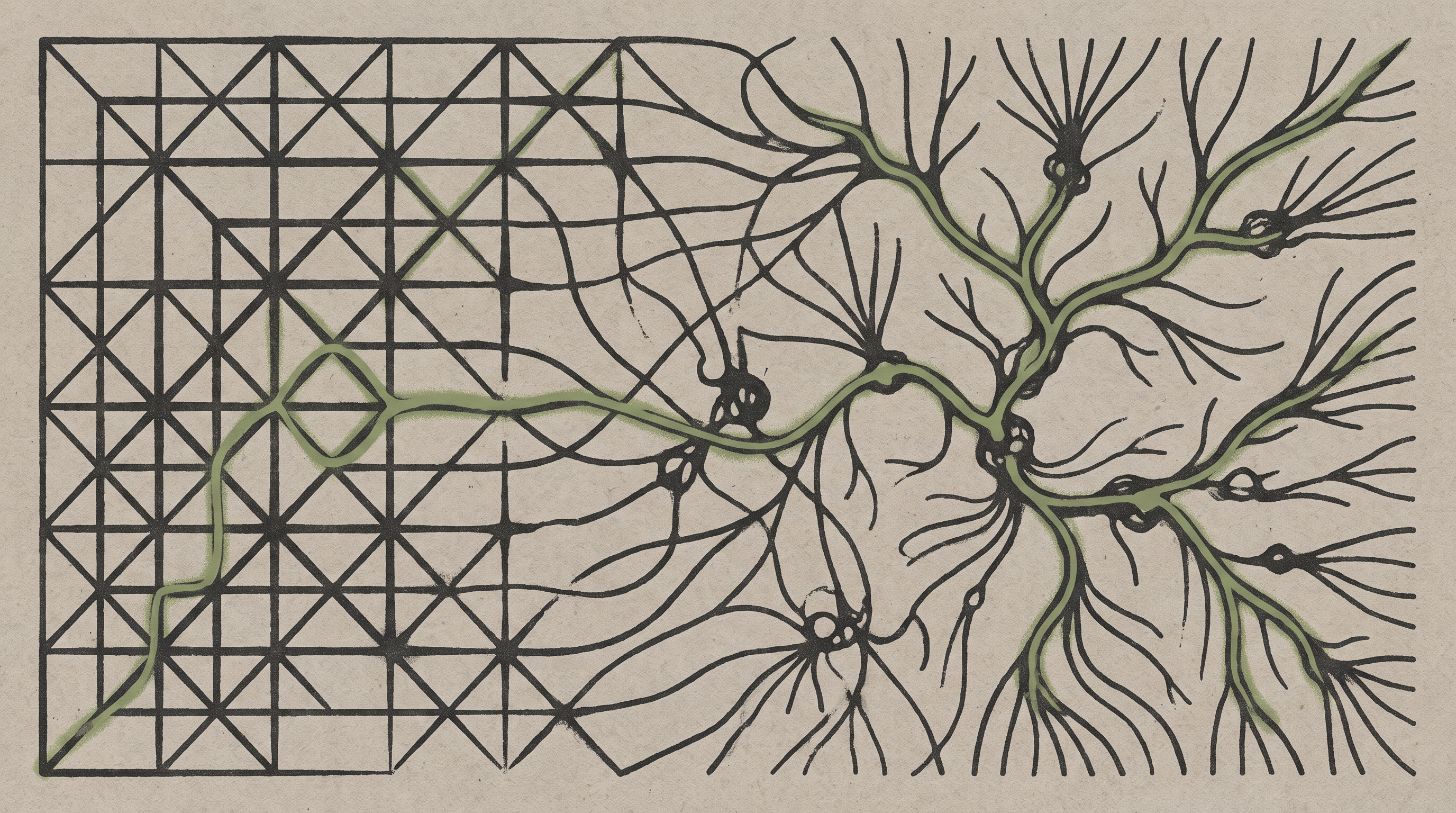
To analyze thousands of evolutionary histories at once, scientists group them into a vast mathematical environment called BHV space. Here, each complete evolutionary tree is represented as a single coordinate point. You can think of BHV space as a bizarre metropolis where different geometric dimensions graft together at severe, ninety-degree angles. Navigating this area requires computing the absolute shortest path between two points, known mathematically as a geodesic.
But this jagged architecture comes with a fatal flaw. In statistics, finding an accurate middle ground is essential for making predictions. In BHV space, this exact geometric average is called a Fréchet mean. Because of the sharp, grafted boundaries of the space, the calculated average often becomes sticky. The mathematical center falls into the geometric crevices where dimensions meet and gets trapped. You can shift the surrounding data points around, but the calculated average refuses to budge.
Computations drag to a grueling crawl, and deriving exact probabilities becomes impossible. To bypass this mathematical roadblock, researchers had to throw out the standard rules of arithmetic entirely.
Entering the Tropical World
A team of researchers looked for a solution in an unorthodox branch of mathematics known as tropical geometry. Despite the sunny name—coined to honor a pioneering computer scientist who worked in Brazil—the field operates on mind-bending rules. In the tropical mathematical world, you don’t add or multiply normally. “Addition” becomes the act of finding the minimum or maximum of two numbers. “Multiplication” turns into standard addition.
It sounds absurd to rewrite fundamental arithmetic. What happens, though, when you apply this bizarre logic to evolutionary trees?
By equipping phylogenetic data with tropical math rules, the researchers constructed a totally new, fluid environment they named palm tree space. In this space, the distance between two evolutionary trees is measured using a new tropical metric.
The results were immediate and striking. Palm tree space unsticks the trapped averages. Because tropical geometry resolves the jagged intersections of BHV space, calculating the shortest path between trees goes from a computationally massive slog to a lightning-fast operation. It transforms the environment into a complete, seamless framework where classical probability laws actually function. But the real test lay outside theoretical equations. How would palm tree space handle real-world pathogens?
Uncovering Hidden Mutations
The researchers fed twenty years of genetic data from the seasonal H3N2 influenza virus into their tropical model. Influenza mutates relentlessly, creating an enormous web of evolutionary history. The team’s goal was to compress this complex data into a clean visual map that captured the most significant evolutionary shifts over two decades.
When they ran the conventional BHV math, it captured a sluggish, narrow view of the virus’s diversity. It identified only a couple of distinct branching patterns in a given year. The tropical palm tree space illuminated hidden subtleties. It explained a vastly higher percentage of the data’s variance and detected six separate evolutionary patterns shifting across the same timeline. The tropical algorithm mapped delicate real-world biological variations that the older models entirely missed.
Building on this, the team deployed a machine-learning algorithm within their tropical framework to classify different categories of simulated genetic models. As the signal-to-noise ratio in the biological data increased, their tropical classifier achieved perfect accuracy.
If a mathematical workaround can untangle the rapid evolutionary history of the flu, it holds the potential to track an aggressive cancer or map the branching physical structures of human neurons. By redefining the very rules of addition, researchers have fundamentally freed biological statistics from its geometric trap.