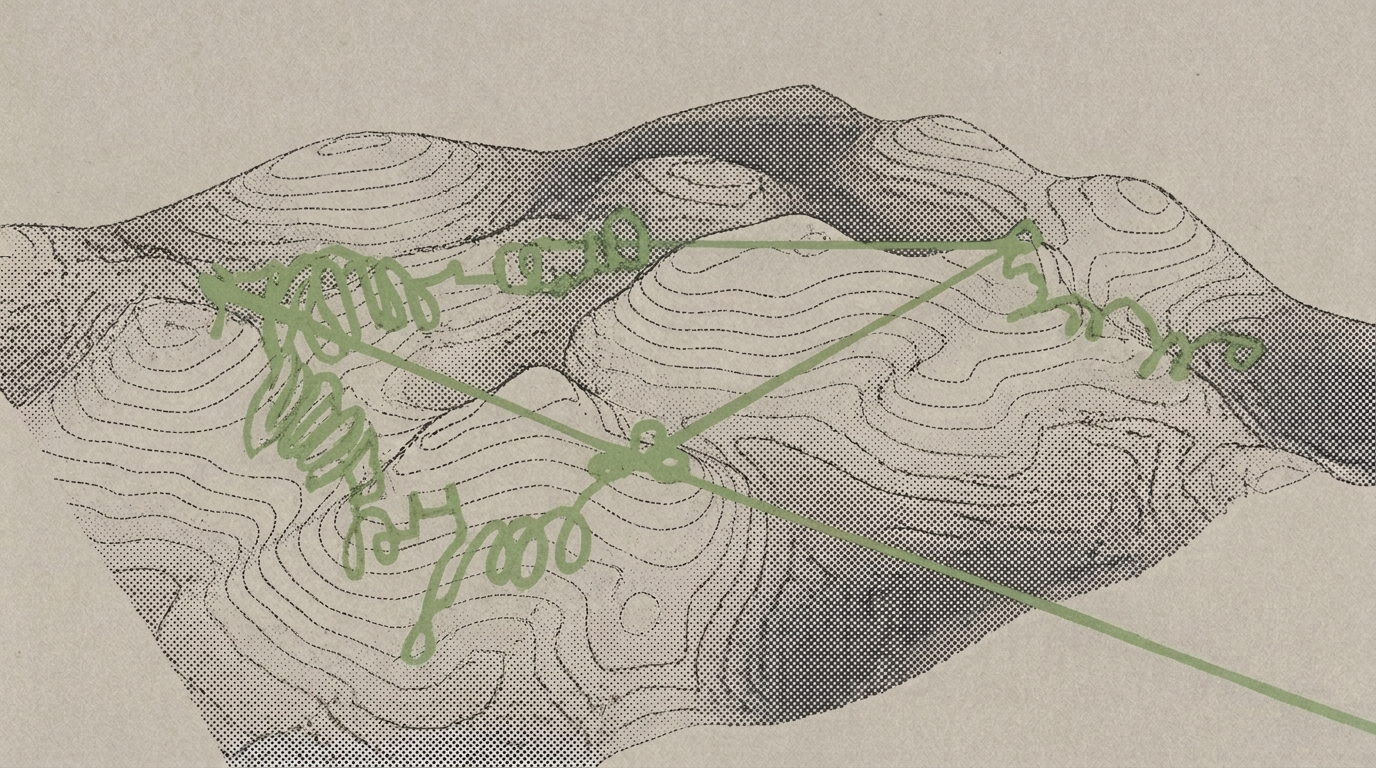
Until recently, artificial intelligence had a crippling reading limitation. If you asked a machine to translate a paragraph, it processed the text strictly word by word, moving from left to right. By the time it reached the final punctuation mark, it had often forgotten how the sentence began. This sequential plodding was not just making AI forgetful; it was creating a massive computational traffic jam.
Then, a team of researchers proposed a radical fix: what if the machine stopped reading linearly and looked at the entire text all at once?
The Sequential Speed Limit
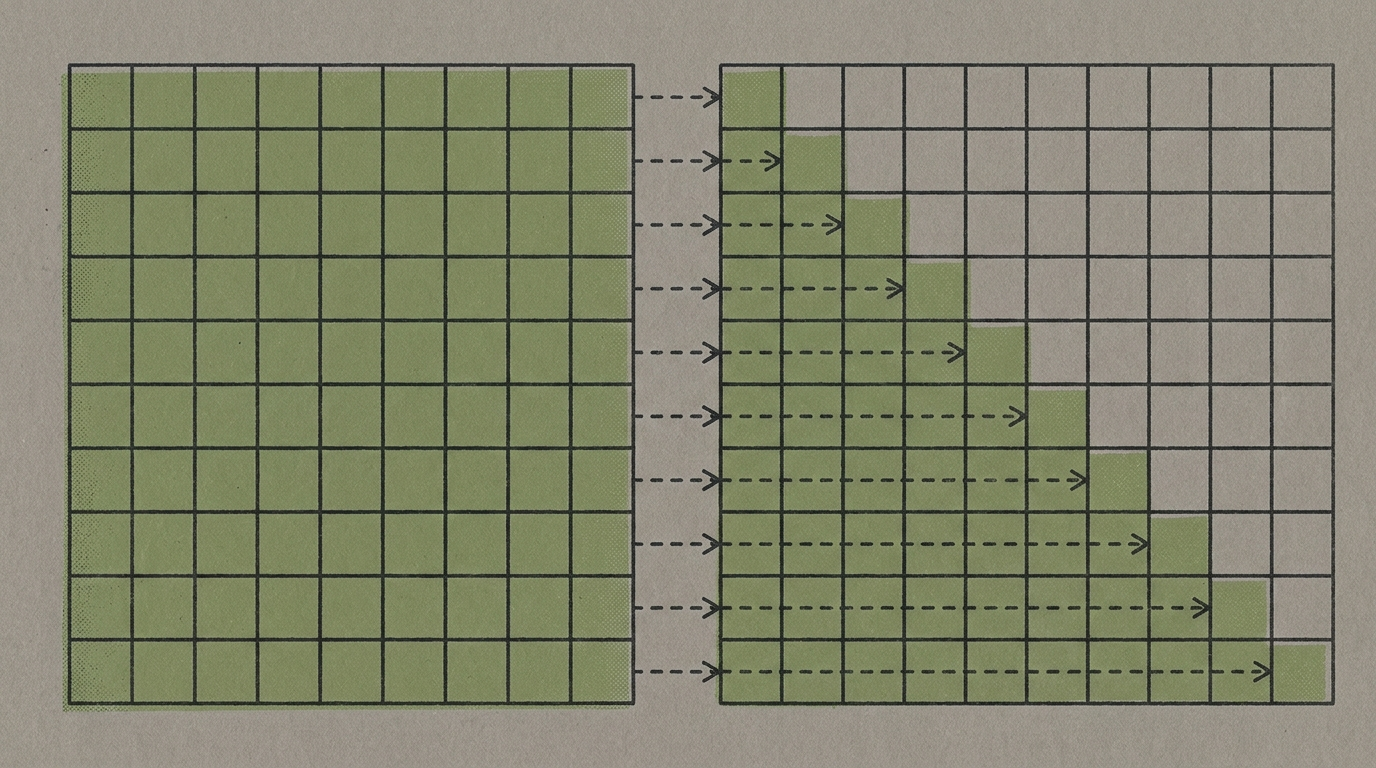
Before this breakthrough, the dominant tools for teaching computers to understand language were Recurrent Neural Networks, or RNNs. These models factor computation along a timeline. To process the tenth word in a sentence, an RNN first has to process the previous nine.
This linear reading imposed a fundamental speed barrier. Modern computer chips, like graphics processing units (GPUs), are exquisitely designed to perform thousands of simultaneous calculations. Because RNNs process data in a strict single-file line, they cannot take advantage of this parallel processing. Information must flow sequentially, and the farther apart two related words are in a text, the more likely the connection between them is lost along the way.
To break this bottleneck, the researchers needed to abandon the timeline entirely.
The Search Engine Inside the Sentence
The solution was a new architecture called the Transformer, built entirely around a mathematical concept known as “Self-Attention.”
In a standard neural network, a word gets crushed into a fixed mathematical container. In self-attention, every word acts like a tiny search engine trying to understand its own context. The mechanism assigns three different roles to every piece of incoming data: a Query, a Key, and a Value.
Imagine walking into a massive library. You have a specific question you want answered, which is your Query. Every book on the shelf has a label describing its contents, which acts as the Key. When your Query matches a specific Key, you pull the book down and retrieve the actual information inside—the Value.
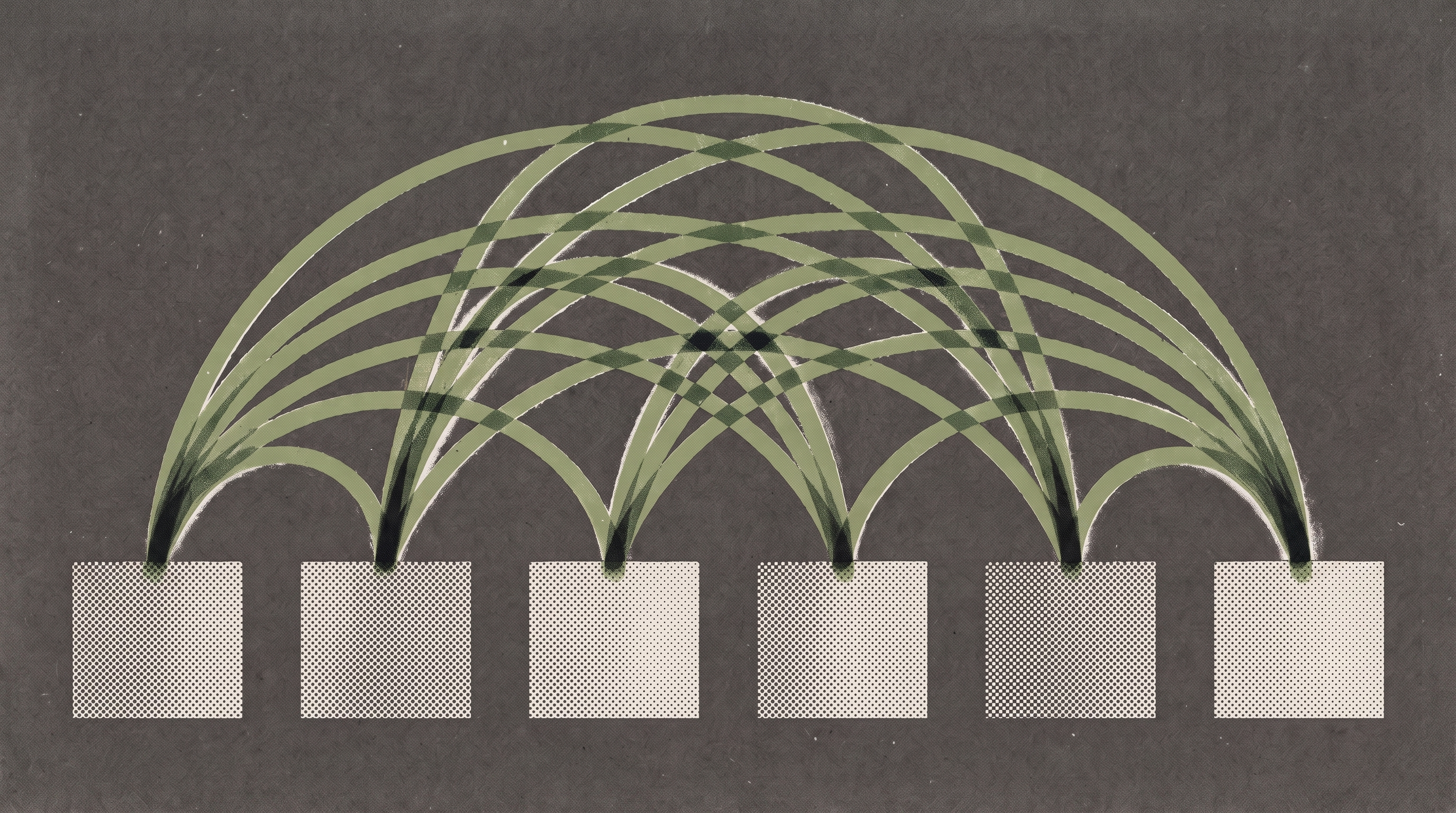
In the Transformer, every single word acts as a Query that checks the Keys of every other word in the sentence simultaneously. By multiplying these numerical Queries and Keys together, the model calculates a score. A high score means two words heavily influence each other. That is what “attention” means mathematically—the network instantly figures out exactly how much focus a word like “bank” should put on a distant word like “river” versus “money.”
Many Scholars at Once
Language is incredibly layered. If the network only calculates one attention score for the whole sentence, it might average out all the possible meanings and lose nuance.
The researchers solved this using a technique called Multi-Head Attention. Instead of relying on one massive calculation, the model splits the math into eight separate, parallel pathways. It is like having a group of scholars analyzing the exact same sentence at the exact same moment. One scholar tracks the grammatical structure. Another tracks pronouns, trying to figure out who “it” refers to. A third absorbs the emotional tone.
This parallel calculation makes the model deeply nuanced and blisteringly fast. But there was a catch.
The Mathematical Clock
If a neural network looks at every word in a paragraph at the exact same instant, it has absolutely no concept of order. To the Transformer, “The dog chased the cat” and “The cat chased the dog” initially look like the exact same pile of disconnected words floating in space.
How could the machine know which word came first?
The researchers provided an elegant solution they termed Positional Encoding. Before handing the text to the model, they inject each word with a mathematical marker made of overlapping sine and cosine waves. Because these waves cycle at different, predictable frequencies, they act like a built-in clock. They apply a unique time-stamp to every piece of data, giving the machine a precise spatial map of the sentence without forcing it to read sequentially.
Shattering the Ceiling
When the researchers unleashed the Transformer on a standard English-to-German translation test, it did not just perform well—it shattered the existing records.
More importantly, it proved the massive advantage of parallel computing. A competing translation model would normally take weeks of expensive computing time to learn its task. The Transformer achieved an unprecedented level of accuracy after training for just three and a half days. By eliminating the single-file line, the researchers completely redefined the speed and cost of training artificial intelligence.
AI is no longer a slow, forgetful reader. The creators of the Transformer immediately recognized they had discovered a universal pattern-recognition engine, predicting this mechanism could easily expand beyond text to handle vast inputs of images, audio, and video. If a machine can instantly grasp how every scattered part of a sequence connects, the boundaries of what our technology can perceive may have just disappeared.