For decades, theoretical physicists have faced a frustrating mathematical crisis when looking at some of the universe’s smallest components. The equations describing neutrinos are so messy and stubborn that a growing group of scientists has embraced “anarchy.” This is the formalized assumption that the rules governing these particles are fundamentally random. If true, this randomness would mean that human beings can never accurately predict how these particles behave. But what if the chaotic numbers are not random at all, but rather the result of a hidden, immaculate geometry?
The Problem with Flavor
Neutrinos come in three types, or “flavors,” much like vanilla, chocolate, and strawberry but for subatomic particles. As they travel through space, they strangely morph from one flavor into another. They also possess very specific, peculiar masses and mixing angles.
To predict these bizarre numbers, physicists historically relied on discrete flavor symmetries. To force their equations to match real-world data, they invented invisible, theoretical entities called flavon fields. Every time a new experiment refined the neutrino data, theorists twisted the dials on these imaginary fields, adding more and more parameters. It became a game of mathematical whack-a-mole that destroyed the predictive power of their theories. If you can always invent a new invisible field to fix your math, the math itself stops predicting anything new.
A Geometric Skeleton Key
Theoretical physicist Ferruccio Feruglio decided to clear away this theoretical clutter. Instead of adding more hypothetical physical fields to fix a broken model, he looked for an entirely new mathematical foundation. He replaced the messy flavons with a concept called modular invariance.
To understand modular invariance, you have to look at modular forms. These are highly symmetrical mathematical functions that depend on a single complex parameter called a modulus, often written as $\tau$ (tau). Imagine looking through a kaleidoscope: when you turn it, the pieces shift, but the overall geometry remains locked in perfect harmony.
Modular forms operate similarly. They restrict equations so rigidly that they leave almost no room for manual tweaking. You lock the shape in place, and the math solves itself.
The Power of a Single Number
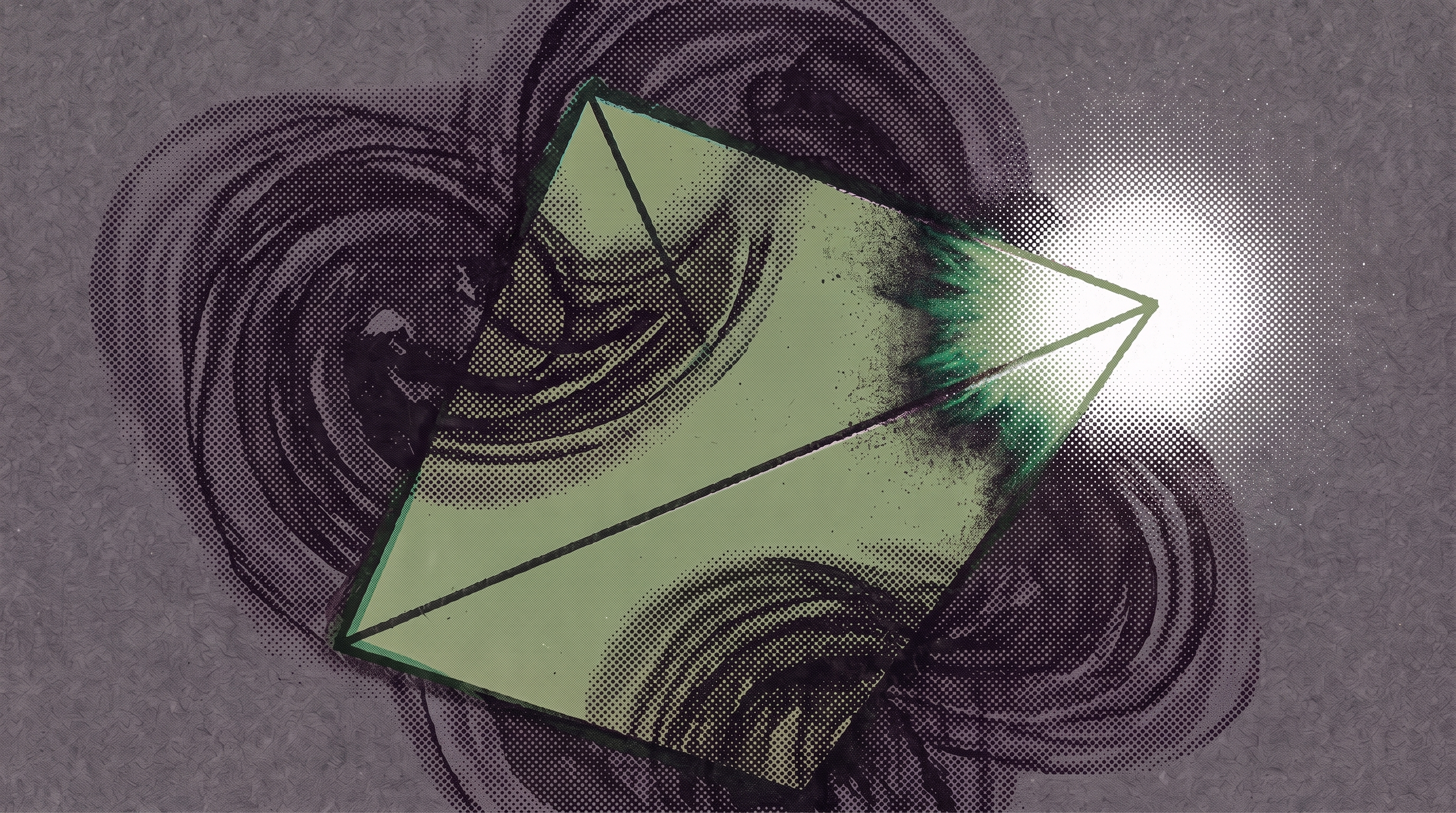
Feruglio built a universe model using a specific level of modular forms, one that naturally maps onto the shape of a tetrahedron. He then forced the superpotential, the mathematical polynomial that dictates particle interactions, to obey these strict rules. He threw out the chaotic flavon fields entirely. Instead, he relied exclusively on that single modulus variable, $\tau$, to dictate the physics.
The result is striking. In his most streamlined model, he proves that eight massive, highly complex variables of the universe emerge from just this one mathematical parameter.
By sweeping across the mathematical space to find a perfect value for $\tau$, Feruglio generated a set of predictions that closely mirror reality. Out of five highly specific real-world measurements related to neutrino masses and angles, his single-parameter model correctly predicts four. It misses the mark on only one measurement — the specific angle at which particles bounce out of a nuclear reactor.
Trapping the Physics
An unexpected mathematical byproduct emerges from this framework. Before this work, physicists knew how to trap continuous symmetries, like the geometry of a perfectly round sphere, into breaking down and giving particles their mass. They struggled to do this with discrete, jagged symmetries, like a rotating triangle or tetrahedron.
By applying modular forms, Feruglio unlocked a way to make discrete symmetries act non-linearly. The variables cannot just wander off into mathematical space. They remain trapped on specific geometric orbits. These rigid orbits naturally force the symmetry to break in exactly the way required to give neutrinos mass, without physicists needing to artificially steer the equations.
Order Out of Chaos
Because that single reactor measurement is slightly off, this specific model is not the flawless, final theory of our universe. Feruglio designed it as a proof of concept. The true victory is proving that a framework built on modular math actually functions.
The fact that one geometric variable successfully replaces an infinite number of hypothetical physics parameters serves as a massive theoretical decluttering. It strikes a definitive blow against the anarchy paradigm. If the universe’s mechanics seem random, scientists might simply be looking through the wrong mathematical lens. By swapping out clunky physical fields for the strict rules of geometric mathematics, the chaos of the quantum world suddenly falls right back into order.