Imagine a cutting-edge, autonomous submarine exploring the deep ocean. You might picture it darting through underwater canyons or weaving past coral reefs. But in reality, most of these sophisticated machines spend their entire journey looking straight down at the seafloor. They navigate by flying safely above the terrain, acting essentially like high-altitude spy planes.
Why do we force our most advanced underwater robots to navigate by staring at their own feet?
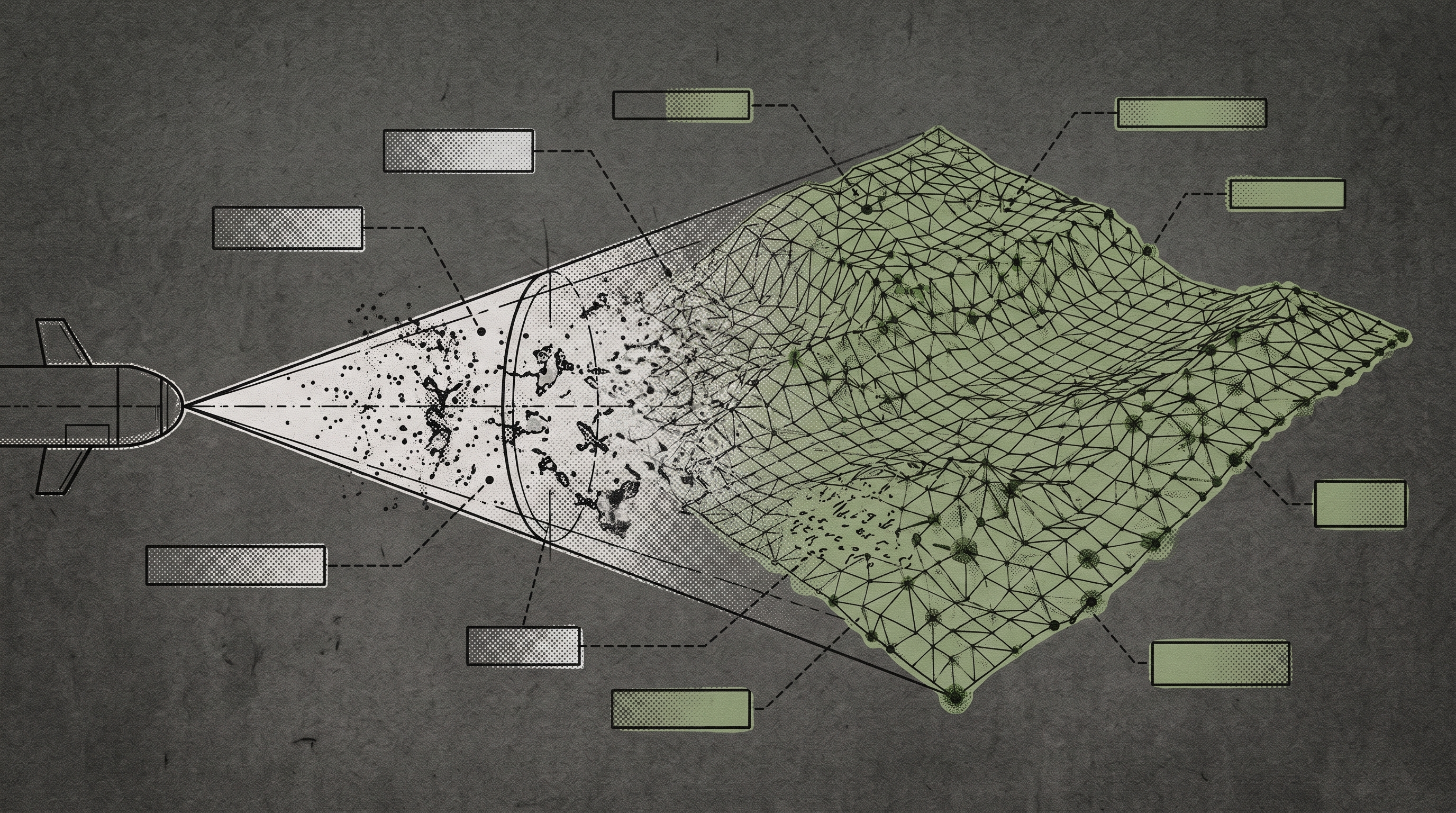
Because looking forward is a technological nightmare. In the air, light travels freely, allowing self-driving cars and drones to see for miles. Water, however, is an actively hostile medium for a camera. Light is rapidly absorbed and scattered by floating particles, creating a blinding, milky haze known as backscatter.
Shallow waters introduce an additional hurdle: caustics. These are the dancing, hypnotic webs of light cast by waves on the surface. To a human diver, they are a beautiful natural phenomenon. To a computer vision algorithm trying to track its environment, they are a chaotic storm of visual noise.
The Scale Illusion
Even if an algorithm can see through the haze, it immediately faces the unknown scale issue. When a robot looks through a single, flat camera lens, it lacks natural depth perception. It cannot tell if it is looking at a small pebble a few inches away or a massive boulder in the distance.
On land, engineers solve this problem by equipping robots with LIDAR, which bounces lasers off objects to measure exact distances. But drop a laser into the ocean, and the water scatters the beam almost instantly, rendering it useless.
How do you teach an artificial mind to navigate a 3D space when its primary senses are stripped away?
You have to give it a perfect answer key. In machine learning, this answer key is called the ground truth. It is a mathematically precise 3D map of an environment that an algorithm can use to test its own guesses. Because lasers fail underwater, building this ground truth has historically been so difficult that almost no forward-looking training data existed for underwater robots.
Building the Answer Key
Researchers Yelena Randall and Tali Treibitz decided to build that data from scratch. They created FLSea, a massive, publicly available collection of over 42,000 underwater images designed specifically to train robots to look forward.
Gathering this data required intense, physical engineering. The researchers built two distinct camera setups. The first used stereo vision, mounting two cameras a fixed distance apart to mimic human eyes and capture natural depth. To ensure the two cameras fired at the exact same millisecond, the team did not just trust their software. They filmed a digital stopwatch and examined the footage frame by frame to verify the synchronization.
The second setup paired a single camera with an inertial measurement unit, or IMU. An IMU is a highly sensitive sensor that tracks physical motion and gravity. By perfectly matching the visual footage with the exact physical movements of the camera, an algorithm can mathematically deduce the scale of the rocks and reefs it passes.
To capture the footage, the team took their equipment to the natural canyons of the Mediterranean and the reefs of the Red Sea. They turned off the thrusters on their underwater drone and had a human diver physically swim it through the water. The diver had to move at a slow, perfectly steady pace, mimicking how an autonomous machine would ideally drive itself.
Old-School Solutions for Future Tech
To solve the ground truth problem without lasers, the researchers went delightfully old-school. Before filming a canyon, divers laid physical measuring tapes and geometric checkerboards of exact known sizes across the seafloor. Later, advanced software tracked how those specific shapes shifted from frame to frame, reverse-engineering a highly accurate 3D depth map of the entire scene. Since the computer knew the exact size of the checkerboard, it could calculate the precise distance to the canyon wall.
The resulting dataset captures the messy reality of the ocean. It includes the blinding transitions from dark caves to sunlit shallows, the blurry water, and the shifting caustic light patterns.
By forcing navigation algorithms to train on the unpredictable reality of the sea, engineers can finally begin building machines capable of handling it. If underwater robots learn to look forward, they will no longer be relegated to floating safely above the unknown. They will finally be able to dive right into it.