Every year, the mountain of human knowledge grows by millions of scientific papers. We increasingly rely on artificial intelligence to search, discover, and organize this overwhelming archive. Yet, the most advanced language models harbor a strange blind spot. They can predict the next word in a sentence with eerie precision, but if you ask them how two entire research documents relate to one another, they stumble. They read the exact words flawlessly, but fail to grasp a document’s place in the wider world.
So how do you teach a machine to see the big picture? A team of researchers found an answer not by looking at the text itself, but at the secret breadcrumbs scientists leave behind.
The Shape of an Idea
Artificial intelligence understands text by translating it into geography. When researchers feed words into a language model, the system converts that text into a dense list of numbers called an embedding. You can think of an embedding as a specific set of coordinates in a high-dimensional mathematical space. Ideally, an AI will place papers about cell division close together in this space, while shoving papers about black hole thermodynamics far away.
But standard models fail at this document-level clustering. Their training forces them to guess missing words within a single paragraph. They never learn to measure the distance between entirely separate ideas.
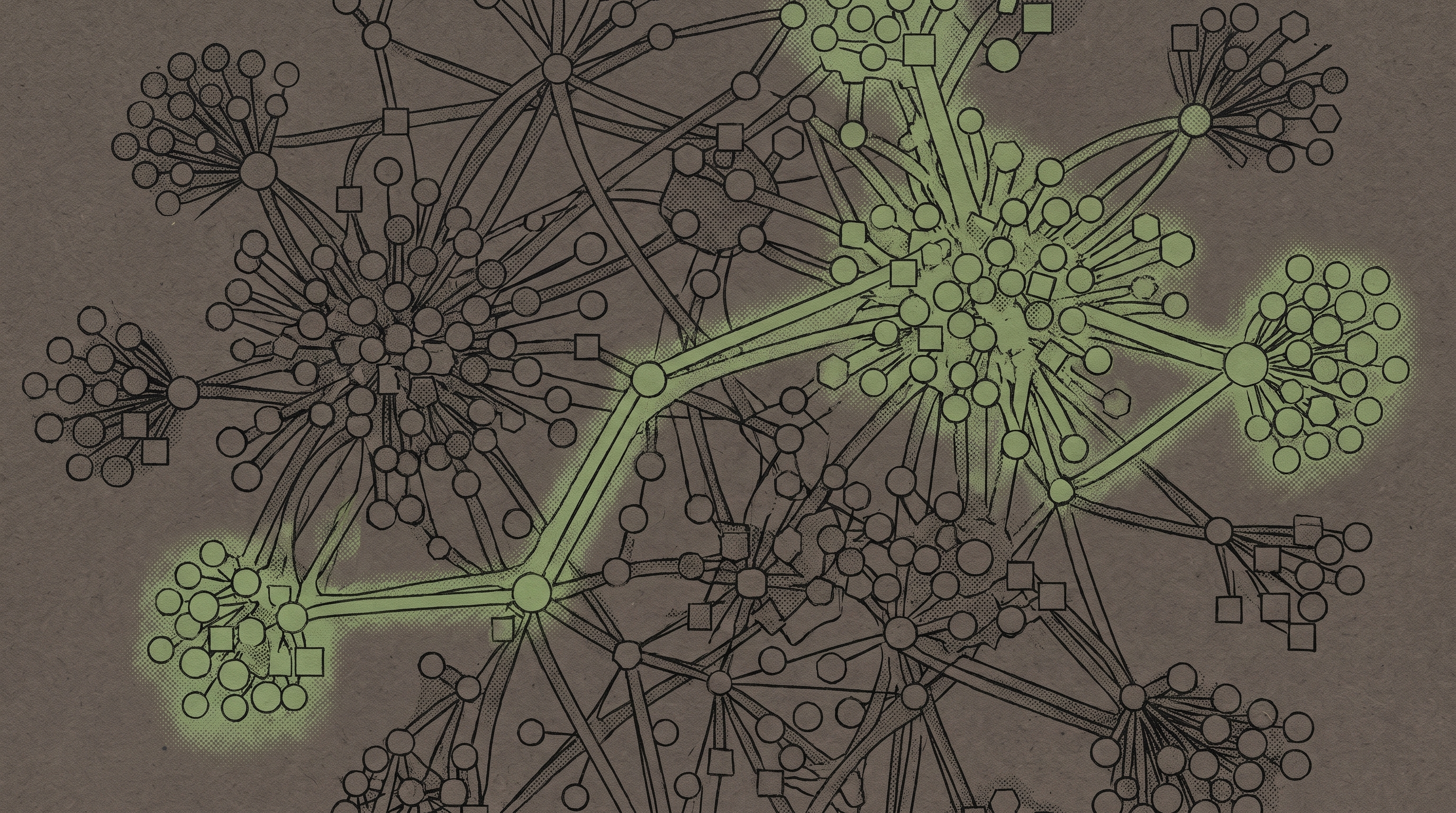
To fix this, researchers built SPECTER, a system that learns to map the scientific universe using citations. Citations are naturally occurring signals of relatedness. If one paper cites another, they belong close together on the mathematical map.
The team trained their model using groups of three: a randomly selected query paper, a positive paper that the query cited, and a negative paper that it ignored. The mathematical system’s only job was to calculate the distance between these summaries, pulling the related papers closer and pushing the unrelated one away.
But the researchers quickly realized the AI was having too easy of a time.
The Curveball
If the negative paper is chosen completely at random, the AI does not have to work hard to spot the difference. Distinguishing a psychology test from a quantum physics experiment is trivial. The model was learning the difference between distinct academic subjects, but not the nuanced relationships within them.
To make the machine smarter, the researchers started throwing deliberate curveballs. They introduced “hard negatives.” Instead of a random distractor, the AI was fed a paper that was cited by the positive paper, but not by the original query. It is the academic equivalent of a friend-of-a-friend. By forcing the system to differentiate between a direct relationship and a secondary one, the AI learned to map incredibly fine-grained boundaries between concepts.
Curiously, as the model grew smarter, the researchers discovered that giving it more human context actually made it dumber.
The Problem With Names
You might assume that knowing who wrote a paper helps categorize it. If an author writes about genetics, their name should be a strong signal to a computer program organizing data. But when the team fed author names into the model alongside the titles and abstracts, the system’s performance dropped severely.
The failure comes down to how language models process vocabulary. When an AI encounters a rare or unfamiliar word—like an unusual human surname—it literally chops the word into smaller, recognizable syllables. Those fragmented syllables might be shared across completely unrelated names, generating false connections that confuse the mathematical system.
Removing the author names completely fixed the problem. This strange quirk yielded an unexpected benefit. Because the system categorizes research relying purely on the scientific content, it can evaluate anonymous submissions or match peer reviewers to papers without being influenced by the prestige of the author.
Mapping the Unknown
The true test of the system is what happens after its training ends. SPECTER uses citations to learn the shape of scientific knowledge, but once it graduates, it never needs to look at a bibliography again.
When a brand new, never-before-cited paper is published, the model requires nothing more than the title and abstract. It digests that brief summary and instantly drops the new paper into the exact right coordinates within the scientific universe. In live tests, this approach improved user clickthrough rates on recommended scholarly articles by nearly fifty percent compared to older text-matching systems.
We are no longer just teaching machines to read our sentences. By feeding them the accidental structures of human behavior, we are teaching them to navigate the architecture of our ideas.